Showing posts with label ankle sprains. Show all posts

Friday, March 9, 2007

ANKLE SPRAINS - REHABILITATION


FROM : SKYLARK MEDICAL CLINIC

Ankle Sprains

Ankle sprains are one of the most common sports medicine injuries.
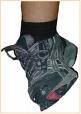
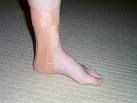
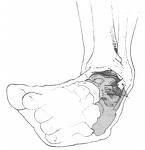
The ankle is stabilized by 3 ligaments on the outside - the anterior talofibular, calconeal fibular and posterior talofibular ligaments (see figure-1st panel, and by a fan-like ligament in the inside-the deltoid ligaments)

Inversion injuries (turning the ankle inward, strain the outer ligaments, while eversion injuries will sprain the inner deltoid ligament. Sprains are classified by degree of severity.

1st degree sprains involve stretching of the ligaments but not tears. There is minimal swelling and instability. Usually the patient may resume sports within a few weeks. This is most common in ankle injury.
2nd degree injuries involve tearing of ligaments with more swelling and bruising. This may take 3-8 weeks to return to sports.
3rd degree injuries involve severe tears of the ligament (yet surgery is rarely required). Because the ligaments are torn it may take 8-12 weeks to heal. Laxity and instability can result of this injury. Many injuries with incomplete tears fall between 2nd and 3rd degree tears.

Treatment of Ankle Sprains
The first thing to do is accurately diagnosing an ankle sprain and not missing other serious fractures that require other treatment.Any injury that is very painful or unable to walk on should be suspected as a fracture and be seen by a doctor. The severity of the injury should dictate the treatment. Even a severe ankle sprain should be kept splinted and on crutches (even if no fracture is seen on the x-ray) since this treatment will also help them heal


Approach to Rehabilitation
Stage 1
- Inflammation (3 days) It is important to rest and splint the ankle. PRICES or Protection, Rest, Ice, Compression, Elevation and Support, will help decrease the pain and swelling associated with the acute injury. An anti-inflammatory drug may be used as well. That will treat both the inflammation and the pain.
Stage 2 - Early mobilization and strengthening (up to 1week) This involves walking on injury (assisted with crutches for partial support if needed). Taping or a brace will also give support. Early exercises to maintain range of motion are important.
Stage 3 - Rehabilitation This involves improving ankle strength, flexibility, and balance. Physiotherapy or athletic therapy is important (this may begin on the 2nd week)
Stage 4 - Late Rehabilitation It is important to ensure that the ankle is adequately strong enough to allow return to sport.
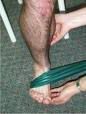

Some advocate 'over-rehabilitation' which refers to the continuing of stretching and exercise programs at home to ensure that this same injury will not reoccur. Often making the athlete stronger than they were before the injury.

Forms of Treatment

Crutches - should be used whenever the injury is very painful to walk on. Gradually crutches may be used less as the injury heals, by allowing more weight to rest on the foot.


Athletic Taping - supportive athletic tape is applied to the ankle to give support. The tape must be applied by an experienced therapist and not left on overnight as it can interfere with circulation
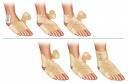
Ankle Braces - commercial over-the-counter braces give similar support to taping but may be easily applied by the patient and are reusable. They may also be used continually to prevent future ankle injuries.

Ankle braces such as "aircast" or equivalent are useful in limiting the injured ankle motion to an up and down plane (dorsiflexion/plantar flexion) but preventing any rolling over. This allows a quicker return to normal activities without re-injuring the injured ankle.

Medications
As mentioned earlier, anti-inflammatories are used at the onset to control inflammation and pain. They are also of benefit later during rehabilitation.
Analgesics such as Tylenol (acetaminophen) give pain control but not ant-inflammation. Glucosamine is a herbal agent that although slower in onset, has anti-inflammatory effects.
Corticosteroid injections are sometimes used in chronic injuries that still have significant pain and swelling but are not used for fresh injuries.

Sunday, March 4, 2007

ANKLE SPRAINS

This week I share two cases of mine. Ankle sprains and osteoartritis genu.


Story from my clinic


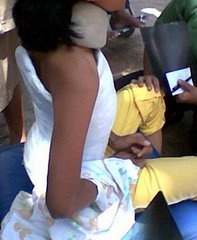
Mrs Dianiati a lady pulmonologyst from a famous hospital in JakartaIndonesia , slipped her ankle while went around a big mall in south Jakarta. Mrs Dianiati did not realized that her left was not already touch the floor, she felt with her left ankle twist to the middle. It is a classic story about ankle sprain. The owner of the groceries do not understand how important to make different color between different high of the floor.

It was so painful, she could not rise immediately. For few minutes she seated on the floor , her lower extremity, below the knee, began edema suddenly.

Roentgen took the day after (Tuesday), bony intack, so the diagnose was ankle sprain. I asked her to visit my clinic, laser administered, diode laser 90 mW; 12 J/cm2 , with probe mode , totally 10 points.

I met her on Wednesday at Cipto Mangunkusumo, edema was gone, just swollen around her ankle. Mobility independently, used sandals, one crutch as cane, but the pain still annoying. Saturday afternoon (3rd March 2007), I gave her diode again but this time for her pain.

(I wrote this report Sunday, 4th oh March 2007.)

Discussion : At her first visited , the laser given to relive the edema, and second visit for the pain.

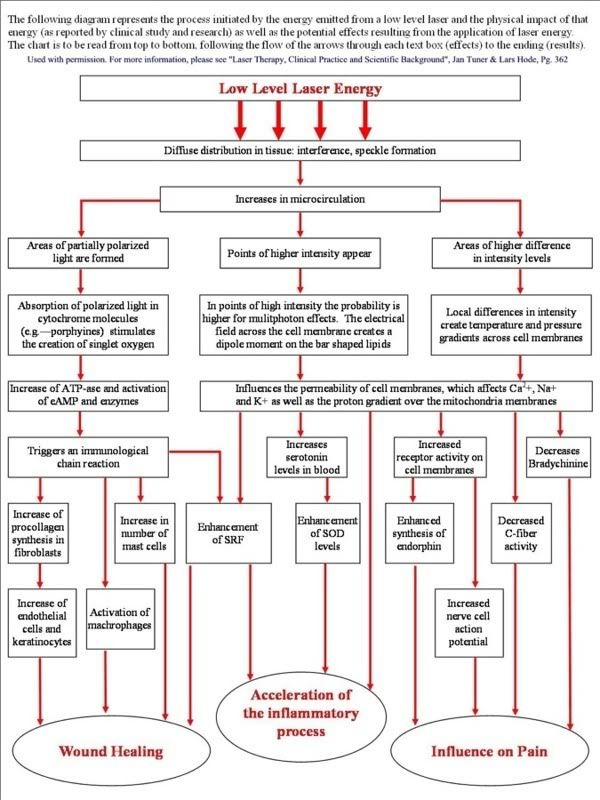
Ussually the recovery will take four weeks, but at the first week, she already ambulation with minimal dependent. Edema decrease because effect emitted energy laser to the microcirculation, and influenced on pain due to effect to the C-fiber activity and bradychinine. (I enclose diagram represent the proces initiated by the energy emitted). The dose and the mode the laser delivery take important place to get best result. It is a therapeutic window must be understand, and also the mode to reach the site of the damage.

Low-level laser therapy in ankle sprains as randomized clinical trial

de Bie RA; de Vet HC; Lensen TF; van den Wildenberg FA; Kootstra G; Knipschild PG

Departement of Epidemiology , Mastrich University , The Netherlands

OBJECTIVE : The test the efficacy of low-level laser therapy on lateral ankle sprains as an adition to standardized treatment regiment, a trial was conducted in which high laser (5 J/ cm2), low-dose laser (0.5/cm2),and placebo laser therapy (0J/cm2) att skin laser level were compared .

DESIGN: Randomized , double-blind, controlled clinical trial with a follow-up of 1 year. Patients, therapist, assessors, and analyst were blinded to the assigned treatment.

SETTING: An ambulatory care setting.

PATIENTS: After informed consent and verification of exclusion criteria, 217 patients with acute lateral ankle srains were randomized to three groups from September 1, 1993 , through Desember 31, 1995.

INERVENTIOS: Twelve treatments of 904 nm laser therapy in 4 weeks as an adjunct to a standardized treatment regiment of 4 weeks of brace therapy combined ith standardized home exercise and edvice. The laser therapy device used was a Ga- As laser , with 25-watt peak power and 5,0000 or 500 Hz frequency, a pulse duration of 200nsec, and an irradiated area of 1cm2.

PRIMARY OUTCOME MEASURES : Pain and function as reported by the patient

RESULTS: Intervention –to- treat analysis of the short term results showed no statistically significant difference on the primary outcome measure, pain (p=.02) and at some points for hindrancein activities in daily life and pressere pain, as well as subjective recovery (p+.05). intention-to-treat analysis showed that total days absenteeism from work and sports were remarkably lower in the placebo group than in the laser groups, rangimg from 3.7 to 5.3 and 5 to 8 days, respectively. The total number of relapsesat 1 year in the low-dose laser group (n=22) was significantly higher (p=.04) than in the other two groups (high laser, n=13; placebo, n=13). Subgroup analysis to correct for possible confounders did not alter these findings.

CONCLUSIONS: Neither high- nor low dose laser therapy is effective in the treatment of lateral ankle sprains.

Arch Phys Med Rehabil. 1998 Nov;79(11):1415-20