Showing posts with label hypokalemis. pain. Show all posts
Showing posts with label hypokalemis. pain. Show all posts
Monday, April 21, 2008


Saturday, March 29, 2008
plexus lumbosacral

The lumbar plexus is a nervous plexus in the lumbar region of the body. It is formed by the loops of communication between the anterior divisions of the first three and the greater part of the fourth lumbar nerves; the first lumbar often receives a branch from the last thoracic nerve.
It is situated in the posterior part of the Psoas major, in front of the transverse processes of the lumbar vertebræ.
Branches
The lumbar plexus differs from the brachial plexus in not forming an intricate interlacement, but the several nerves of distribution arise from one or more of the spinal nerves, in the following manner: the first lumbar nerve, frequently supplemented by a twig from the last thoracic, splits into an upper and lower branch; the upper and larger branch divides into the iliohypogastric and ilioinguinal nerves; the lower and smaller branch unites with a branch of the second lumbar to form the genitofemoral nerve.
The remainder of the second lumbar nerve, and the third and fourth lumbar nerves, divide into ventral and dorsal divisions.
The ventral division of the second lumbar nerve unites with the ventral divisions of the third and fourth lumbar nerves to form the obturator nerve.
The dorsal divisions of the second and third nerves divide
| Division | Name | Source | Target |
| Main | Iliohypogastric nerve | 1 L. | Skin over the lateral gluteal region and above the pubis [1] |
| Main | Ilioinguinal nerve | 1 L. | Skin over the root of the penis and upper part of the scrotum (male), skin covering the mons pubis and labium majus (female) |
| Main | Genitofemoral nerve | 1, 2 L. | Genital Branch: Cremaster muscle, skin of scrotum/labia majora Femoral Branch: Skin on anterior thigh |
| Dorsal | Lateral femoral cutaneous | 2, 3 L. | Skin on the lateral part of the thigh |
| Ventral | Obturator nerve (and Accessory obturator nerve, when present) | 2, 3, 4 L. | Medial compartment of thigh |
| Dorsal | Femoral nerve | 2, 3, 4 L. | Anterior compartment of thigh |
| Ventral | Lumbosacral trunk | 4, 5L., 1, 2, 3, 4 S. | Sacral plexus |
into two branches, a smaller branch from each uniting to form the lateral femoral cutaneous nerve, and a larger branch from each joining with the dorsal division of the fourth nerve to form the femoral nerve.
The accessory obturator, when it exists, is formed by the union of two small branches given off from the third and fourth nerves.

Saturday, March 22, 2008
low level laser for plantar fasciitis

Usually the is 30 Joule/ treatment, using Diode
But 5 years ago, for one patient, 60 years old lady, near 90 Joule needed . Used simultaneusly with calcaneal pad,the pain gone till this days.
streching forPlantar Fasciitis Prevention

Hold each stretch for at least 30 seconds — don't bounce — and do one or two repetitions two to three times a day. Clockwise from upper left: 1. To strengthen arch muscles, place a towel on the floor, grab the towel with your toes and pull it toward you. 2. While sitting, grasp your toes and gently pull them toward you until you feel a stretch in the arch of your foot. Stretch one foot at a time. 3. Stand as shown, with your back leg straight and heel down. Move your hips forward until you feel a stretch in your calf. Switch legs and repeat. 4. Stand on a step near the bottom of your stairs, put your weight on the ball of one foot and slowly lower that heel until you feel your calf muscle stretching. Repeat on the other side.
© 1998-2008 Mayo Foundation for Medical Education and Research (MFMER). All rights reserved. A single copy of these materials may be reprinted for noncommercial personal use only. "Mayo," "Mayo Clinic," "MayoClinic.com," "EmbodyHealth," "Reliable tools for healthier lives," "Enhance your life," and the triple-shield Mayo Clinic logo are trademarks of Mayo Foundation for Medical Education and Research.
Saturday, December 29, 2007


Monday, July 2, 2007
Low Level Laser for Hypokalemia- Update
Yulia, lovely young lady, hospitalized for 7th times due to "paralysis". Yulia dearest, your working diagnosis was hypokalemia.

Discussion :
What is that?
Symptoms
The common symptoms for this kind problem are muscle weakness and cramping, and paralysis like yours, also paresthesias, palpitations, constipation, nausea or vomiting, abdominal cramping, polyuria, nocturia, or polydipsia.1
What is kalium?
Kalium or Potassium is one of the body's major ions. Nearly 98% of the body's potassium is intracellular. The ratio of intracellular to extracellular potassium is important in determining the cellular membrane potential. Small changes in the extracellular potassium level can have profound effects on the function of the cardiovascular and neuromuscular systems.1
Pretty Yulia, Potassium is about working of a cell.
How about the normal level
The reference range for serum potassium level is 3.5-5 mEq/L, with total body potassium stores of approximately 50 mEq/kg (ie, approximately 3500 mEq in a 70-kg person).
Hypokalemia is defined as a potassium level less than 3.5 mEq/L. 1
Moderate hypokalemia is a serum level of 2.5-3 mEq/L. 1
Severe hypokalemia is defined as a level less than 2.5 mEq/L.1
Pathophysiology:
Hypokalemia may result from conditions as varied as renal or GI losses, inadequate diet, transcellular shift (movement of potassium from serum into cells), and medications.
Laser for Hypokalemi
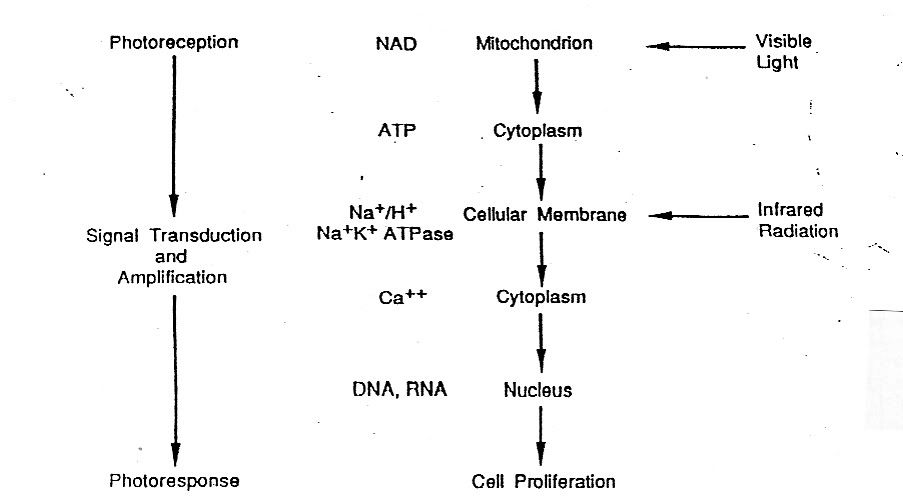
Your father came to me , wonder if Low Level laser Therapy (LLLT) could work on this condition. I found Karu’s model. Karu’s model shows , light is absorbed by components of repiratory chain ( i.e. flavine dehydrogenase, cytochomes and cytochromes oxidase) which causean activation of the respiratory and the oxidation of the NAD pool , which leads to changes in the redox status of oth mitochondria and the cytoplasm. This in turn has an effect on membrane permeability/ transport , with changes in the Na + /H+ ratio and increase Na+/K+ ATPase activity.
How about your's dear?
The last time you were in hospital, your number just 1.5 mEq/L.(Severe hypokalemi). I gived you LLLT by transcutaneus, 45 minutes everyday, 10 times. It worked! At 4th administered, although your kalium still below 2.5 mEq/L, you felt strong enough, no muscle weakness. It was amazing.
Discussion :
Inadequate diet and GI problem could explained Yulia's . His father told me, her appetite not so good. She also prone for diarrhea.
So dear, yet LLLT help you , please take times to visit gastroenterologist.
Author: David Garth, MD, Consulting Staff, Department of Emergency Medicine, Mary Washington Hospital : eMedicine Specialties > Emergency Medicine > Endocrine And Metabolic ; Hypokalemia; Last Updated: September 20, 2005
Subscribe to:
Comments (Atom)